Seasonal Outlook: Winter 07/08
(Produced October 3, 2007)

Well, first things first. If there is one item that you take with you after reading this outlook it should be: There is no way to reliably predict the weather on a seasonal scale! Those of you who have been following my site know that I have always been pretty low key and skeptical of any seasonal forecast- even my own. In fact I like to use the work "outlook" as I feel "forecast" should be reserved for something that has a little more proven science behind it.

For those of you that are relatively new to the site, you might want to click here and read my "Soap Box Speech on Seasonal Forecasting". For those of you that have read it before, no need to again- it is the same as in years past.

Now with that said, lots of folks still want me to produce a winter forecast, so here it is:


Unlike last year when the sources of good news for snow lovers were scarce, I believe there is reason for optimism this snow season. Not that I am guaranteeing all of the Midwest will see above average snowfall and a colder than average winter, but I think there are several factors occurring that all point to enhanced chances that at least a good portion of the Midwest will see average to below average temps and that will lead to average to above average snowfall.

The three factors that I see contributing to chances for a decent winter in the Midwest are: 1) The existence of a weak La Nina that should persist through the winter months and perhaps even grow to a moderate one. 2) The fact that below average temps and above average snowfall have not been seen for large areas of the Midwest in many years. 3) The presence of above average temps across the Midwest so far this Autumn. Of these three, the presence of a La Nina is the strongest argument, with the other two factors lending some hope, but do not have strong scientific support.

To expound on these three items a bit more, the existence of a La Nina does not guarantee a cold and snowy winter across the Midwest, but it does increase the chances for it to occur. Much like the El Nino last winter produced a mild and rather scant snow season last winter and in many of the previous El Nino winters (Figure 1), the opposite tends to occur when a La Nina is occurring. An area of below average temps establishes across the Canadian Prairies and extends down into the northern ½ of the Midwest (Figure 2).

It should be noted that a weak La Nina tends to produce a better chance for below average temps in the Canadian Prairies and north central US than a strong one, although each La Nina has its own personality and there are no strict rules to follow here.

It should also be pointed out that La Nina typically does not cause precipitation to be any more or less than average across the Midwest (Figure 3), but if temps are below average, then it is likely that more of the precip that falls across the Midwest will fall as snow rather than something else and the snow that falls will stick around longer as the occurrence of thaws would be less common. It has always been my battle cry to get people to hope for a cold winter more than anything else as it would produce the kind of conditions that snow lovers like more than a winter that sees above average snow, but also pronounced thaws that eat into that snowpack and make for poor snow-play conditions.

The second point (lack of a cold and snowy winter in a large portion of the Midwest in the past several years) is one that I have been using for a few years now and is not one that can be a great indicator of the upcoming winter, but the bottom line is mother nature can only produce so many winters with above average temps and below average snowfall before she has to swing things the other direction.

It is possible that we have entered into a period of 10-20 years in which wintertime temps will tend to be above average and snowfall will tend to be below average across the Midwest, but even in these multi decade temperature trends, there are years that will buck the trend. Since the mid 80’s the trend towards warmer than average winters and average to below average snowfall seems to be occurring, yet there have been standouts like in 1995 and 2001. With the La Nina looking to be in place, perhaps this is one of those years will buck the long term trend we seem to be in right now.

The third point bears a resemblance to the second in its thinking and mechanics, only on a smaller time scale. So far this meteorological autumn (since September 1) has produced above average temps across a good portion of the Midwest. It is my opinion, based on some evidence in the past, that a warm autumn can lead to a colder and snowier than average winter. The data to support this is not overwhelming, but I see lots of snowlovers get excited when October turns cold and snowy across the upper Midwest (like last year), only to be followed by a winter that turns out to be a bust (like last year). There have also been years in which autumn temps were milder than average (78,79, 94, 01) and then as we worked through the middle of November a shift in the overall jet stream configuration occurred and that led to below average temps and above average snowfall across the Midwest.

It can be a little nerve wracking to have to endure, but I have noted that the longer the warm anomaly can persist into October or even early November, the better the flip seems to turn out. I would not even be overly concerned if we get to very early December and the flip has not occurred. Although if the flip does not occur through the middle to end of December, then all bets are off! Also, if the flip occurs at the middle to end of October, that is not as good as early to middle November, but there is still no reason to hit the panic button. It may just be a case where the flip has occurred earlier and could then persist through the winter.

So in a nutshell, there are several reasons to be optimistic about this winter. Obviously there are no guarantees and even with in a colder and snowier than average winter, there are the occasional thaws- especially in areas south of the Northwoods. So folks in places like southern MN, WI and lower MI as well as IA and northern sections of IL, IN and OH should not get your hopes up that temps will fall to below freezing in December and stay there until March. It just does not happen that way, even in the coldest of winters.

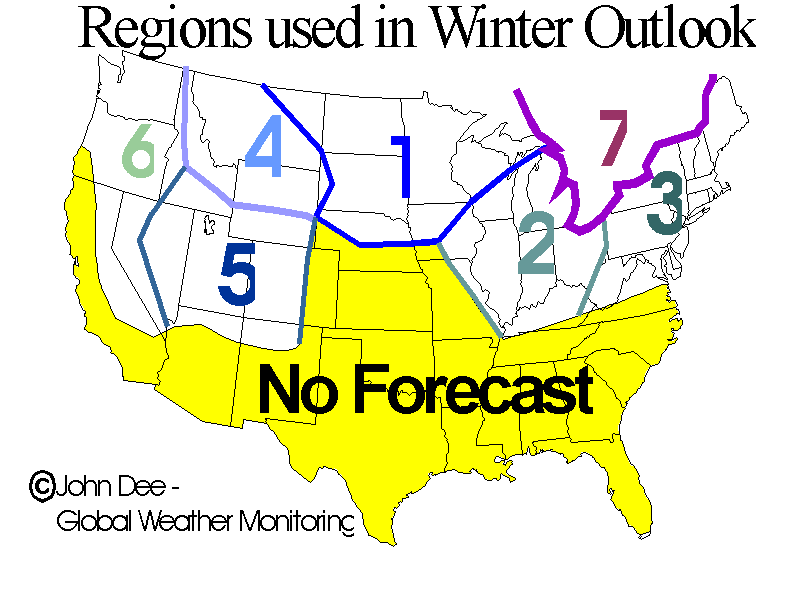
Below are the details to the forecast for the different regions of the northern US:

REGION 1 – The Northwest Midwest: Most of this region stands a good chance to see below average temps occur during the winter of 07-08. The existence of a La Nina is the main driving force for this idea. The further north you go the stronger the chances for below average temps you will see. So that means that areas like NE and IA have a small chance for below average temps, whereas areas like ND and northern MN have the best. As for snowfall, I see better than average chances to occur, but mainly because I believe the colder than average temps will cause more of the precip to end up falling as snow rather than something else. The other thing that the colder than average temps would do is to allow the snow that falls to stick around. This would lead to deeper snowpacks as the season progresses and a longer window of opportunity for snow play in these areas as well.
The colder than average temps in the northern Midwest could also lead to above average snowfall for the Lake Effect Snow belts of the Midwest.
The last point I want to make is that La Nina can cause temps in the far southern Midwest to be above average. The thermal gradient between these two anomalies would be a good breeding ground for low pressure systems. These systems like to form where there is a strong temperature contrast in a short distance and those low pressure systems could bring some decent system snows to the upper Midwest.
Overall, the indications for much of this region for a good winter season are about as strong as I have seen in several years. No guarantees, but plenty to be optimistic about!

REGION 2 – The Southeast Midwest: The news for this region is not as rosy as it is for the NW Midwest, but I do not see anything to be too concerned about. As mentioned in the region 1 write up, La Nina can actually cause the far southern Midwest to see above average temps, but we are talking about areas more down along the OH River and not in the true snow belts of the Midwest. It is possible that this type of warm anomaly could extend further north and impact areas like northern IL, IN and OH, maybe even into far southern WI and lower MI, but the rule of thumb is that the further north you go in the Midwest, the less chance of above average temps you will have.
As for snowfall in these areas I do not see a strong reason to go one way or the other. Because of the potential for more storms to roll across the Midwest, the potential for above average snowfall is there. However, much of this region may end up on the wrong side of some of these storms and end up seeing something other than snow fall. The exceptions to this being the far northern sections of lower MI which could be far enough north to not only be included in the below average temperature anomalies that the La Nina creates, but it may be far enough north to catch mainly snows with the storms that roll through.
I guess in a nutshell the ideas for this region would be for an average winter overall, with slightly better chances than average for cold and snow in the far north and slightly less chances than average for cold and snow in the far south.

REGION 3 – The Northeast US: I do not see any strong signals to go one way or the other for this region. The La Nina should not have a direct impact on this region and I do not see any other factors pointing towards one thing or another. I can say that is has been a few years since they saw a whopper of a winter in these parts, so there may be a slight trend towards a colder and snowier than average winter, but the signals to me are just not as strong as they are for the north central US.
So in a nutshell I think the NE US will see at least an average winter, meaning average temps and average snowfall. There may be a slight trend towards a snowier than average winter, which could include several Nor’Easters. However that signal is not a strong one, so I am not giving it a great chance. On the flip side, I do not see any strong reasons why this winter would be a poor one for snow and cold. That is not to say it is impossible for it to happen, but I would not be overly concerned about it right now.

REGION 4 – The Northern Rockies: Many of these areas saw a fairly poor season last year. There were a few bright spots in Jan and early Feb, but overall, most snowlovers in these areas would just as soon forget about last winter.
The news for this winter is better. Perhaps not as good as it could be, but I do expect that the La Nina could contribute to a colder than average winter for these spots and I also expect a stormier than average setup to occur across the northern ½ of the US for the winter, so that would mean there are prospects (but not promises) for above average snowfall in these areas. It may be a case where early Autumn snows are above average and then a period of quieter weather puts the fear of another poor snow season into the minds of the folks in the northern Rockies, but any quiet period in Nov and early December might just be a head fake, with true winter weather to come in by mid December and not let go for most of the season.

REGION 5 – The Central Rockies: This region saw an OK winter in some spots and a below average winter in others. My feelings for this winter are that this winter will be pretty much the same. Some spots will do OK, while others will not do as well as they would like. I believe that the further north you go the better the chances for average to above average snowfall and below average temps you will have.

REGION 6 – The Pacific NW and Sierra Range: Much like last winter, I expect this area to see above average temps and average to above average precip. Thus it will be a case where elevation will play a huge role in how much snow falls. The higher the elevation the more snow. I know this is the case everywhere out west, but I guess what I am trying to say is that some places that are usually high enough to see mainly snow fall with a storm may see rains occur more than average this winter. So you will have to go even higher than you might normally have to go to hit the snow line with many of the storms this winter.

REGION 7 – Eastern Canada: I should really break this region into two separate regions as it is big enough. In any case, I expect the western sections of this region (Ontario mainly) to see average to above average snowfall, with close to average snowfall in Quebec and the maritime provinces. Temps across Ontario will be average to below, with the best chances for below average temps occurring the further east you go. Temps across Quebec and the Maritimes will be close to average overall.